
Context
The workflow
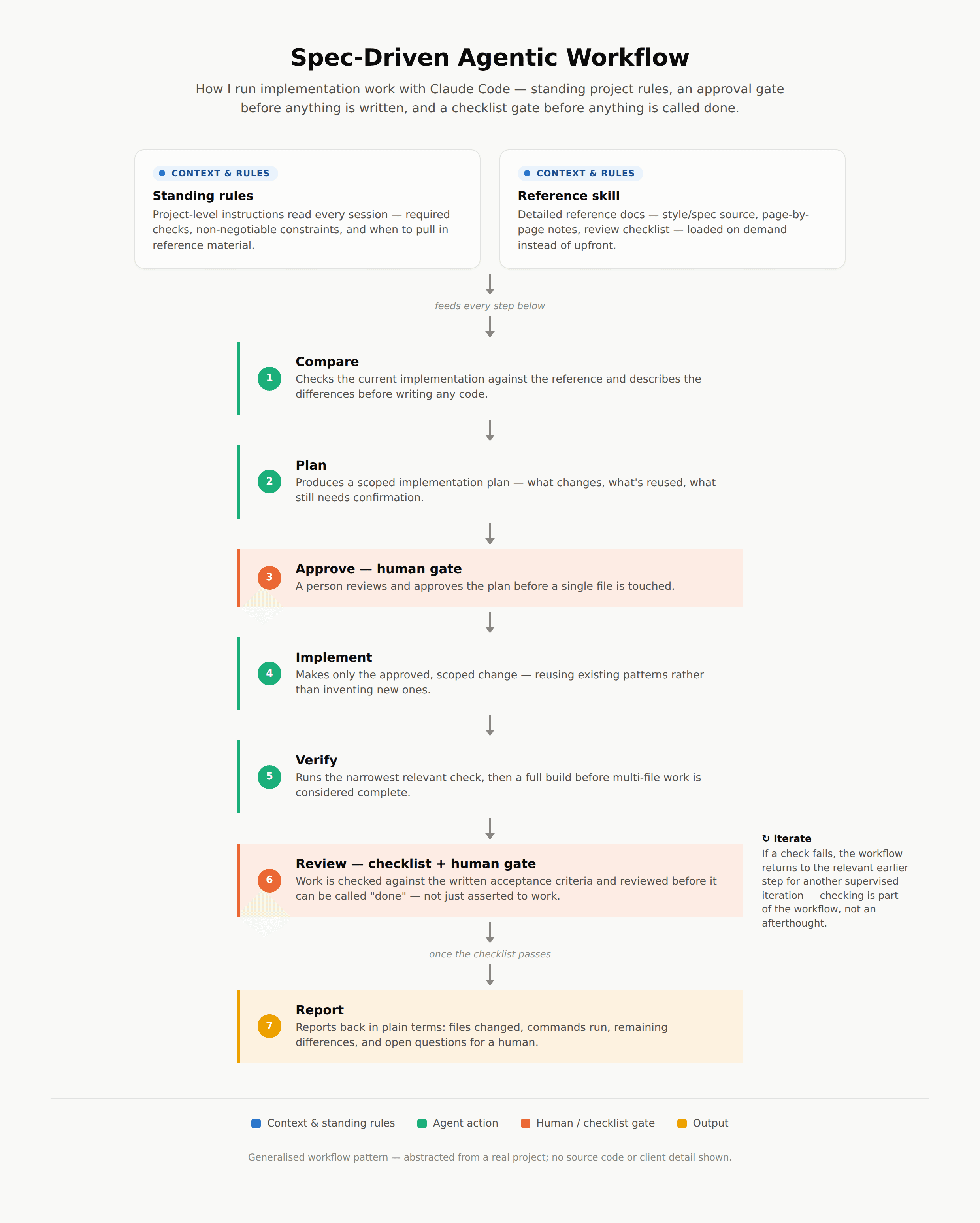 Two things carry most of the weight.
The definition of done is written first, and it is a file. Acceptance criteria live in the repository as a checklist, alongside separate documents recording approved messaging, factual boundaries and what may and may not be published. An agent may only tick a criterion once it has genuinely been verified. Because the criteria are committed, they outlive the session that produced them and can be checked by anyone afterwards.
Checking is a step in the workflow, not an afterthought. A failed check returns the work to an earlier step rather than being reported as a caveat. There are two human gates: one before any file is touched, and one before anything is called done.
Two things carry most of the weight.
The definition of done is written first, and it is a file. Acceptance criteria live in the repository as a checklist, alongside separate documents recording approved messaging, factual boundaries and what may and may not be published. An agent may only tick a criterion once it has genuinely been verified. Because the criteria are committed, they outlive the session that produced them and can be checked by anyone afterwards.
Checking is a step in the workflow, not an afterthought. A failed check returns the work to an earlier step rather than being reported as a caveat. There are two human gates: one before any file is touched, and one before anything is called done.
Real run evidence
8 August 2026 run date50 minutes continuous358 agent turns230 tool calls0 human prompts during execution
- Written definition of doneAcceptance criteria and the factual boundaries the work had to stay inside were committed to the repository before implementation began.
- No human implementation prompts during executionFifty minutes from goal to final report. The input log, which records typed input only, holds no human keystrokes in between.
- Parallel research agentsRead-only agents mapped the stack, the routes and the component conventions concurrently, each returning findings rather than raw files.
- Independent review agentA separate agent — read-only, without the implementing agent's context — checked the output against the source documents. The agent that wrote the content was not the agent that approved it.
- Automated validationLint, production build, route status and computed colour contrast inside the run; Playwright end-to-end and visual-regression suites across desktop and mobile over the same body of work.
- Blockers preserved rather than bypassedThree criteria that needed unavailable access were left unchecked and documented, not ticked and not worked around.
- Reviewer findings fed back before completionTwelve findings, two of them blockers, were applied before the run reported done — including a claim it had written itself that contradicted its own source material.